Version 4.0.0 — available now

mac4DSTEM
Four-dimensional STEM analysis, native on Apple silicon.
A macOS application that takes 4D-STEM datasets from raw detector frames to calibrated strain, orientation, and phase maps — interactively, against a live view of the data.
- macOS 27+
- Apple silicon
- Metal & Neural Engine
- GPL-3.0
- Free
Try it — real data, in the page
A real 4D-STEM scan of a NiCu alloy. Every scan position holds a full diffraction pattern, and each space produces the other: the detector mask on the left integrates to the virtual image on the right, and the region you pick on the right integrates to the pattern on the left. Computed in your browser.
Loading the dataset…
Drag to move · scroll for outer radius · shift-scroll for inner
Drag to select a region · scroll to resize
The workspace
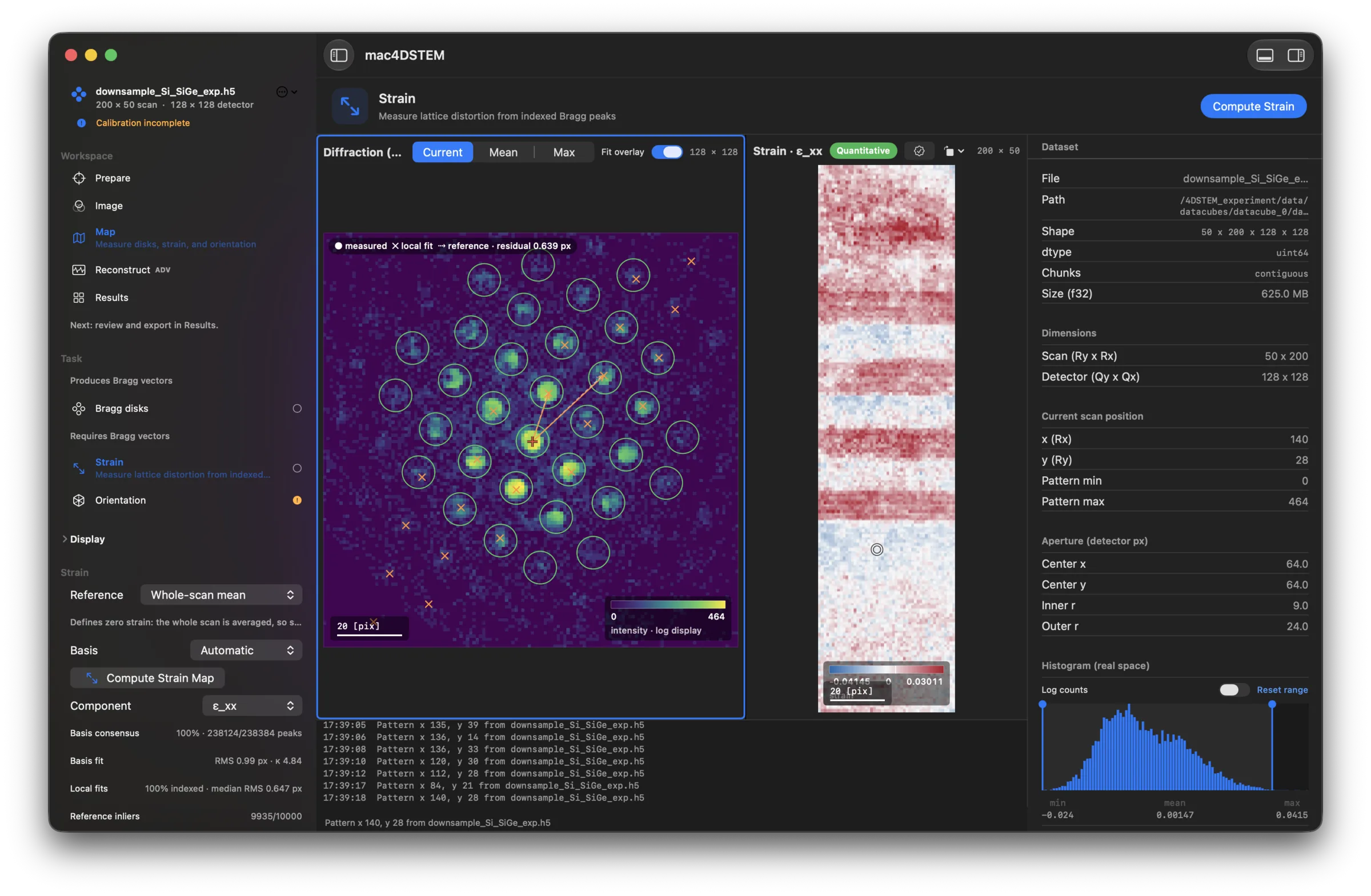
Capabilities
-
Data exploration
Real and reciprocal space presented together, with calibrated scale bars, contrast control, and GPU-rendered CBED display.
-
Virtual imaging
Bright-field, annular dark-field, and HAADF geometries, plus arbitrary annular, rectangular, and point detectors positioned interactively on the diffraction plane.
-
Calibration
Probe and origin fitting across the scan, elliptical distortion correction, real–reciprocal rotation, and reciprocal-space sampling against a known crystal.
-
Bragg disk detection
Cross-correlation with parabolic and DFT-upsampled subpixel refinement, and live acceptance diagnostics. Disks can also be found by a trained model running on the Neural Engine.
-
Strain mapping
Robust local lattice fitting against a whole-scan or region reference, with basis consensus, residual, and indexed fraction reported alongside every map.
-
Orientation mapping
Polar-correlation template matching against a validated crystal catalogue or an imported CIF, with reliability and inverse-pole-figure output.
-
Phase reconstruction
DPC, iDPC, parallax, and single-slice ptychography.
-
Interoperability
EMD export of Bragg vectors, calibrated datacubes, and preprocessed products, readable directly in py4DSTEM.
Provenance and validation
The analysis algorithms are ported from py4DSTEM and measured against it on experimental datasets, so results are traceable to the established reference implementation in the field. Work published using mac4DSTEM should cite py4DSTEM for the underlying methods.
Every quantity carries its calibration and provenance through display, export, and reopening. Where a measurement is not quantitatively supported, the result is labelled accordingly rather than presented as though it were.
That verification is numerical — the application is tested against known-correct values, not against its rendered output.
- Reference
- py4DSTEM 0.14.19
- Test suites
- 30 automated
- Parity harnesses
- Experimental data
- Export
- EMD (py4DSTEM-readable)
- Runtime
- Self-contained
- Licence
- GPL-3.0
Availability
-
Version 4.0.0 complete
The analysis workflow is finished and covered by automated tests, including parity harnesses measured against py4DSTEM on experimental data.
-
Download
Version 4.0.0 is available as a signed, notarized disk image. Open it and drag mac4DSTEM to your Applications folder — it launches without a security warning, and needs nothing else installed.
-
Source release
The source is published on GitHub under GPL-3.0.
-
Distribution
Direct download only. The Mac App Store is not a route for this application: its terms are incompatible with the GPL-3.0 licence mac4DSTEM inherits from py4DSTEM. It stays free either way.
Requires macOS 27 or later on Apple silicon (for macOS 14–26, version 3.0.0 remains available). No external runtime, toolchain, or library installation is needed — all dependencies are contained within the application. The Merlin MIB and EMPAD RAW readers are preview-grade pending further vendor data.
Enquiries, issue reports, and collaboration
If you work with 4D-STEM data and something here is useful — or missing — I would like to hear about it.
mail@mac4dstem.com